Rethinking the Odds: What Thai Bettor Mindset Reveals About American Gamblers Selling Themselves Short

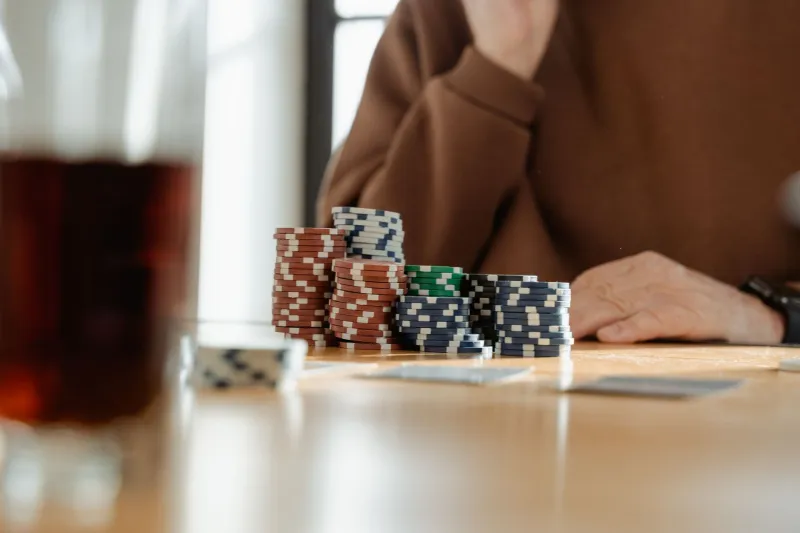
Photo: focused poker player studying cards at casino table with chips, via thumbs.dreamstime.com
Here's something that might sting a little: the house edge isn't what's costing most American bettors their money. Their attitude toward it is.
Walk into any casino in Vegas or fire up a betting app on a Sunday afternoon, and you'll hear the same resigned commentary echoing through the crowd. "The house always wins." "You can't beat the math." It's practically a national gambling mantra at this point — a built-in excuse that lets players off the hook before they've even placed a chip.
But spend some time in Thai betting communities, or on platforms like UFABET2233 that have deeply absorbed that culture, and you'll notice something striking: Thai bettors don't talk about the house edge the same way. Not even close.
The Number Isn't the Enemy — Your Relationship With It Is
Let's get one thing straight. The house edge is real. A blackjack table running a 0.5% edge isn't going to magically flip in your favor because you believe hard enough. Nobody's arguing that.
But here's where Thai gambling philosophy diverges from the Western default: acknowledging a mathematical disadvantage is not the same as surrendering to it.
In Thailand's betting culture — shaped by generations of strategic wagering on everything from Muay Thai bouts to card games played at family gatherings — the house edge is treated less like a verdict and more like weather. You can't stop the rain, but you can absolutely decide when to go outside, what to wear, and how long to stay.
American bettors, by contrast, often treat the edge as a full stop. The statistic becomes a story they tell themselves: I'm going to lose eventually, so it doesn't really matter what I do. That passive fatalism is arguably more damaging than any percentage point the casino tacks on.
Active Adaptation vs. Passive Acceptance
One of the most interesting patterns you see in Thai betting communities is what you might call "edge awareness without edge paralysis." Players study the numbers, sure. But they use those numbers to make decisions — not to justify inaction.
Take game selection as a basic example. A Thai bettor who understands that baccarat carries a lower house edge on the banker bet than most slot machines doesn't just file that away as trivia. They use it to shape their entire session strategy. They're asking: Given this edge, what bet size makes sense? At what point does the variance work in my favor over a short session? When do I walk?
American bettors often know the same statistics — there's no shortage of gambling math content online — but the knowledge doesn't translate into behavior change. It just becomes another fun fact to share at the bar.
The difference isn't intelligence. It's the psychological framework around the information.
Case Study: The Short-Session Mindset
Here's a real-world pattern that illustrates this gap pretty clearly.
Research into gambling behavior has consistently shown that the house edge becomes more punishing over longer sessions. The more hands you play, the more the math grinds you down toward that theoretical loss percentage. This isn't controversial — it's basic probability.
Thai bettors, particularly those who frequent platforms with structured wagering environments, have long embraced what amounts to a short-session philosophy. Get in, execute a defined strategy, and get out before the edge has time to compound. It's disciplined, almost businesslike.
Many American bettors do the opposite. They sit down with $200, lose $150, and then extend the session trying to "get back to even" — which is precisely when the house edge does its most efficient work. The emotional response to losing actively feeds the mathematical disadvantage.
Flip that around. Enter a session with a pre-set win target and a hard stop-loss. Treat the house edge as a time-sensitive factor rather than an inevitable outcome. Suddenly, you're not fighting the math — you're working around it.
Why Americans Underestimate Themselves
This isn't about cultural superiority or suggesting Thai bettors are born with some mystical gambling gene. It's about what gambling culture reinforces.
In the US, casino marketing has spent decades selling the fantasy of the big win while quietly normalizing the idea that losing is just part of the deal. The house edge gets absorbed into the entertainment cost framing — "it's like paying for a movie ticket, except sometimes you win." That framing isn't wrong exactly, but it completely removes the player's sense of agency.
Thai betting culture, at least in its more disciplined expressions, doesn't let players off the hook so easily. There's an expectation that you've done your homework. That you understand the game mechanics. That you're not just throwing money at a screen and hoping for the best.
That expectation creates a different kind of bettor — one who sees a 1.06% house edge on a banker bet not as a depressing inevitability but as a workable number, a constraint to strategize around rather than a ceiling to cower under.
Practical Shifts You Can Make Right Now
None of this requires a philosophy degree or a trip to Bangkok. Here are a few mindset adjustments that translate Thai-style edge awareness into your actual betting habits:
Know your game's actual edge. Not a vague sense of it — the real number. Baccarat banker bets sit around 1.06%. Basic strategy blackjack hovers near 0.5%. Many slot machines run 5% or higher. These aren't equivalent, and treating them like they are is leaving money on the table.
Define your session parameters before you start. A win target and a loss limit aren't just responsible gambling tools — they're strategic ones. They prevent the house edge from compounding through emotionally extended play.
Separate the edge from the outcome. One session's result tells you almost nothing about the mathematical edge. Short-term variance is enormous. Thai bettors who stay disciplined across dozens of sessions see the edge for what it is — a long-run factor — and don't let a bad night rewrite their strategy.
Play fewer hands, better. More action doesn't mean more opportunity. Against a house edge, more action usually means more exposure. Quality over quantity is a surprisingly underrated concept in American betting culture.
The Bigger Picture
The house edge will always exist. Nobody at UFABET2233 is going to tell you otherwise, because that would just be nonsense. But the gap between a player who treats that edge as a conversation-ender and one who treats it as a strategic variable? That gap is enormous — and it's almost entirely psychological.
Thai betting culture has spent generations cultivating the second type of player. The good news for American bettors is that mindset isn't inherited. It's learned. And the first step is pretty simple: stop using the house edge as an excuse, and start using it as information.
Your next session might look exactly the same on paper. But the decisions you make inside it? Those can be completely different.